Christopher Sainsbury
Interim Head of School of Music and Professor of Music, Australian National University
ANAM Set Composer (2024); ANAM Keynote Speaker for Day One (2024)
The ANAM Set was a rewarding experience, I think for all of us. I was able to explore regionalism in music again, which is where one draws upon motives and images from their local region and reconstitutes them in new ways in creative works that affirm and/or sound a sense of regional identity, even at times suggesting a remote tending of the land.
I wanted to write for two pianos and in working with Reuben Johnson (piano 2024) and ANAM Artistic Director Paavali Jumppanen we discussed the theory and practice of regionalism just as much as the dots and the specs of the performance. They readily embraced my regionalist world with real understanding and expression. Paavali centres the word ‘collaboration’ in so much of what he does, and although I deliver very specific dots to performers, together we three totally got into the whole thing, talking at length, and exploring sound worlds of regional Australia.
One way to do this was simply to listen to old forgotten pianos in states of disrepair, both played and importantly sitting unplayed – that’s a sound, the silence. Thankfully we found two poor upright pianos at the Abbotsford Convent. Such pianos were the pianos I grew up with in regional Australia. They were in all of our old School of Arts halls, Church halls, surf clubs, schools, some were utilised, but by the 1960s and 1970s (when I grew up) many simply sat in the corner, suggesting community that may have once gathered there, past events and perhaps a once healthy community music-making scene, now silent. (In those years I did hear them in performance very occasionally but mostly their time had passed).
The timbres you get from an old (broken) piano coupled with a modern grand are not only wonderful but for me very meaningful. It’s an interesting way to write, to think what timbres hold meaning for me as a composer. I owned such timbres from my youth, as they were part of the fabric of regional Australia. But as mentioned it’s a sound world that is now essentially silent, like the communities and institutions who have passed on or aged with the pianos. My piece for the ANAM Set was called Interrupted Cadence, for two pianos, partly in homage to these past or passing sound worlds, interrupted by other technologies in music, other spaces, and by various new music styles and genres. It starts with the Queen’s birthday motive because her portrait was in all of those halls, and then falls into a slow clock ticking theme suggestive of the fact that time passes. The sound world becomes quite dense in the middle sections. Late in the piece we hear a child practicing exercises, excerpts of repertoire with a regionalist twist – with wrong notes, the clock again, and silence. The upright had to have a hidden microphone to lift its cutting power to that of the fine grand for balance's sake.
In terms of creative aesthetic, to my eyes and ears ANAM centres collaboration in much of what they do. And I think when the refining of great technique holds hands with a culture of collaboration then you get musicians who can make meaningful contributions to the music industry and importantly to communities with which they are involved. We must remember that industries are based in communities and I think the ANAM management in Paavali and Nick totally get that, they live it! So, bit by bit the students are finding in themselves a cultural growth that is wider than music itself, and I think any national institution doing that is in the right place.
Part of this centring of collaboration is that they engaged me as a consultant in the Indigenous space – on engaging with Indigenous composers, culture, and history. I met with staff, and I gave the Keynote Speech at the beginning of the academic year 2024. They also got James Henry and Brenda Gifford in too, to share with and work with musicians from their own perspectives, and they retain a plan to do similarly for new cohorts of musicians, as well as a proven track record of commissioning First Nations composers.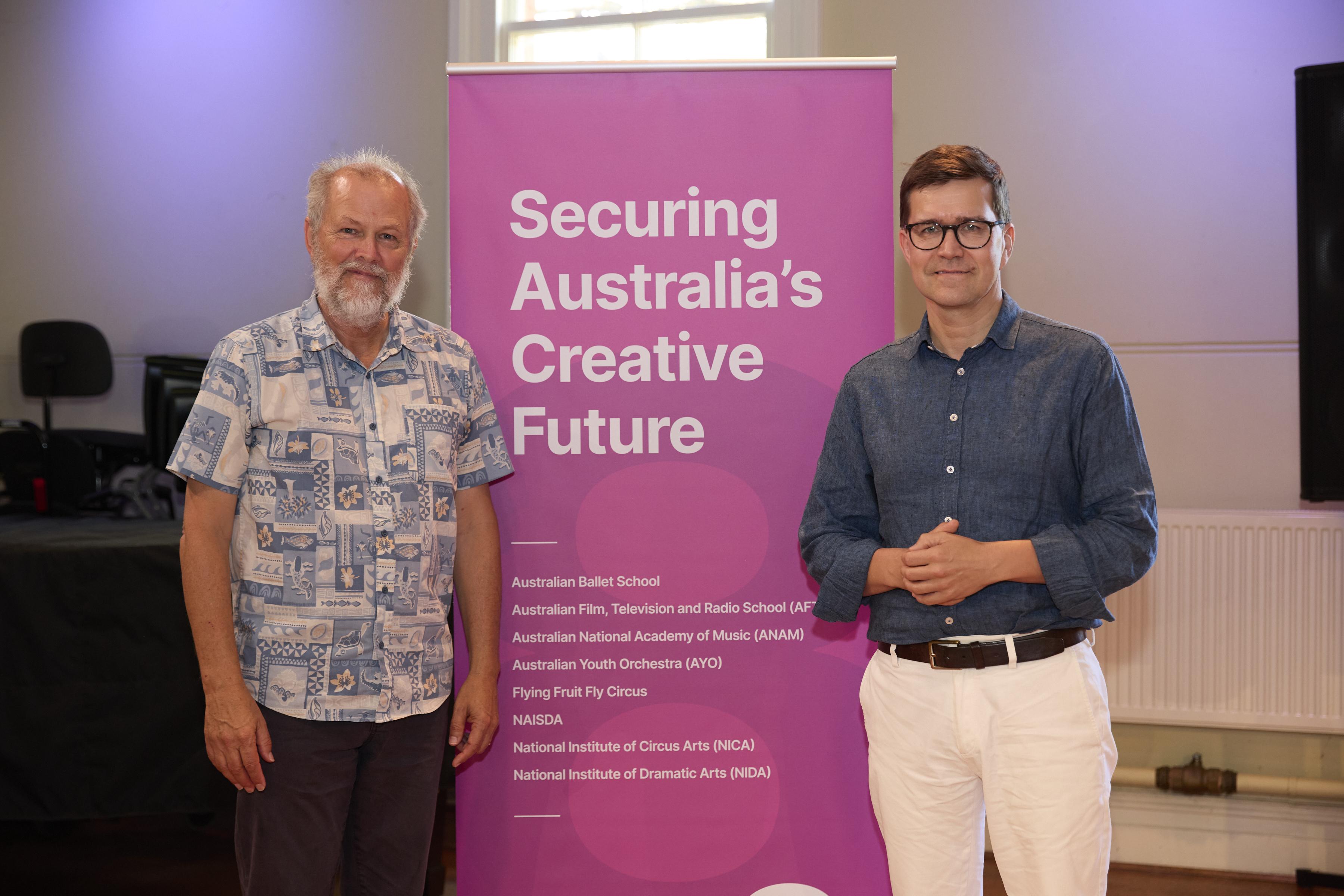
Christopher Sainsbury and Paavali Jumppanen, Day One at ANAM, February 2024. Photo credit: Laura Manariti.
At ANAM, the students are finding in themselves a cultural growth that is wider than music itself. I think in undergraduate studies most students do not necessarily develop that breadth, and at that stage nor should they be expected to. Their main interest is pretty much purely music. ANAM sits well for after undergraduate studies or even after post-graduate studies. Over and above music, its word is ‘meaning’, and its broader language is ‘culture-making’, for the young musicians, for the music industry, for communities and for the larger nation.
Christopher Sainsbury headshot supplied