Words by Timothy O’Malley, ANAM Musician, piano (VIC)
Robert and Clara Schumann both hold positions as central characters in the popular narrative of Romantic music’s history. Robert was a prolific composer and music critic who suffered alternating bouts of depression and creative fervour. Clara has perhaps been comparatively neglected in this narrative; alongside Liszt and Chopin, she was one of the most famous and well-lauded virtuoso pianists of that era. Together they were a bona-fide 19th Century musical power couple (or throuple if you include both Robert’s alter egos: Florestan and Eusebius) and their mutual inspiration bore a bounty of artistic brilliance.
This union, however, was hard-earned. The pair met while Robert was under the tutelage of Clara’s father, Friedrich Wieck, himself a renowned pianist and teacher. Friedrich was a champion of Robert’s work and even co-founded the magazine Neue Zeitschrift für Musik, giving Robert both a platform and consistent work. The tragedy in some ways writes itself, Robert and Clara fell in love and Friedrich was staunchly opposed. He sent Clara on a long series of concert tours to keep her from Robert and forbade contact, but of course this only intensified their mutual longing.
Smuggled love letters and ardent pining snowballed in 1837 to a written proposal from Robert, promptly accepted by Clara, and immediately turned into a lengthy legal proceeding by Friedrich. Friedrich encouraged his daughter’s career in composing and performing and sought to protect Clara’s ability to pursue this further, something that he perceived would become problematic after marriage.
What ensued was an ugly battle in court, Friedrich attacked Robert’s character calling him a lazy, depressed alcoholic. Robert secured Felix Mendelssohn as a character reference and eventually won the case, marrying Clara and having her father sentenced to 18 days in prison following a successful defamation counter-case.
Clara was caught in the middle, facing either estrangement from Robert whom she loved, or from her father, her teacher and mentor. But ultimately it was Robert that she chose, and together they built a life in Leipzig. A shared diary detailing the first years of their marriage gives a colourful insight into the prodigiously talented couple’s domestic affairs. Under their own pens, stories are told of the revolving door of Romantic era
A-listers including Liszt, Mendelssohn, Moscheles and Härtel. The Schumanns recounted their study of Bach
and Goethe, their ambitions as composers, and the horrible Philharmonic conductor in London who could not keep time with Clara while she played Robert’s concerto.
Ever the sympathetic and doting husband, Robert noted one day that Clara had given birth. This came after months of somewhat baffled comments that she did not, in fact, seem in totally perfect health. In another entry, he ruminated on how many of Clara’s ingenious ideas were never followed to their logical end, for “the Artist must give many an hour to the Mother.”
While Robert was able to be the auteur and recluse, toiling for days on a single composition, Clara was the family's main breadwinner, running the household and raising the children. She adored Robert and protected his ability to compose, often at the cost of her own.
Despite these challenges, and being a full-time concert virtuoso, she remained a composer, with works still in the Romantic canon. Her love for Robert was channeled into her music, and in the same vein, the ‘Clara motif’ permeates Robert’s own voice. Clara in Robert, Robert in Clara: “Clobert” or “Rara” – they are a highly shippable duo.
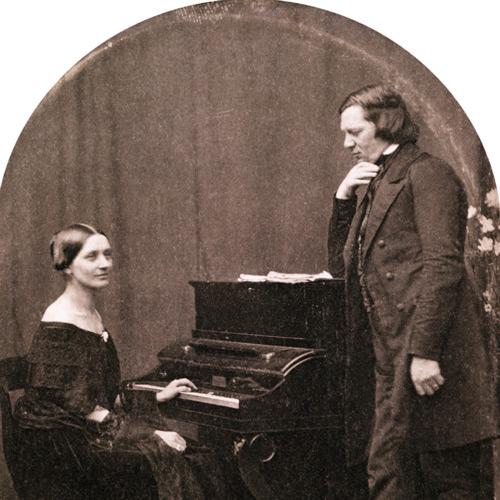
Image: Clara and Robert Schumann in an 1850 daguerrotype, Credit: commons.wikimedia.org
CLARA and ROBERT
Thursday 15 October 3pm
The Good Shepherd Chapel
ANAM Musicians
Tickets from $25