In the thirtieth year of ANAM, instrumental training focuses not only on technique, repertoire, and performance, but also on creative conceptual thinking and artistic citizenship. It is in this context, that the ANAM 2026 Chamber Music Festival, has turned a curatorial focus towards environmental and climate storytelling through centuries of classical music. Contemporary classical music composition and performance is increasingly influenced by the climate crisis and the series of global issues intertwined with it. This manifests not only in the development of sustainable practices surrounding the presentation of music, but also in the music itself. Ranging from the abstract and reflective, to data translation, or ecological integration of the natural world in creative practice, classical music offers us a uniquely engaging form of climate communication.
As a percussionist and artistic researcher, my work with The Sound Collectors Lab at Monash University focuses on the role of classical music in our communication about, around, and during the climate crisis, and how musicians’ creative engagement with climate is influencing the evolution of classical music. In 2026, we commence Climate Vocabularies, an Australian Research Council Discovery Project in new music exploring how climate systems scientists and musicians work together. The disciplines of the arts and the sciences are driven by questions about the unknown aspects of ourselves and the universe we are part of, and both disciplines engage creative and experimental methods to explore these questions and to reveal the results to audiences.
I am delighted to be part of the ANAM Chamber Music Festival, working with extraordinary ANAM musicians on repertoire by Bree van Reyk (alum 1998), Kate Milligan, Thomas Meadowcroft, and Augusta Read Thomas. Curated in collaboration with the ANAM team, each work on this program offers insight into ways musicians have creatively engaged with scientific materials, practices, researchers, and their findings in their works over the past ten years.
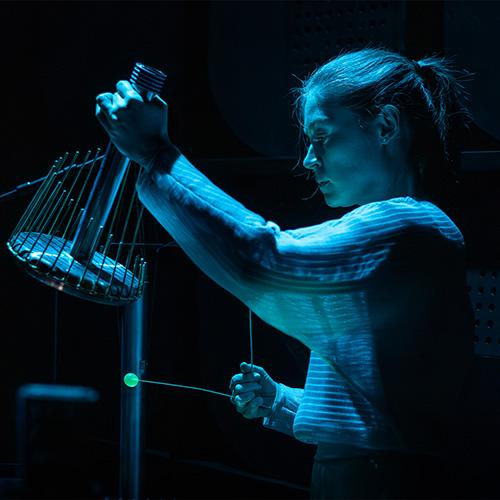
Bree van Reyk’s How We Fell (2021) was composed for violinist Anna McMichael and my project Climate Notes. The creative point of departure for a series of new works for violin and percussion were science communications researcher Joe Duggan’s collections of handwritten letters from international climate scientists responding to the question: ‘How does climate change make you feel?’ Van Reyk’s How We Fell draws on text fragments from letters authored in 2015 and 2020, responding to the initial question as well as to the scientists’ written responses through music. Performed on recycled instrumental sculptures of tuned piano wires, resonant saw blades, and clusters of porcelain tiles called ‘replica trees’, each performance continues an ongoing, asynchronous conversation around daily life at this point during the climate crisis. For this festival, the ANAM musicians’ own responses are integrated into the score and performance, connecting themes from 2015 to 2026.
Kate Milligan’s Nocturne I (2022) is a solo percussion work performed from a score comprising hi-res photographs of bioluminescent algae. The algae Pyrocystis Fusiformis produce a flash of cold light as a chemical response to movement, such as water disturbance from waves or the approach of predators. This response only occurs during the night, a nocturne of light and movement. The bioluminescent gestures of the algae form the basis of the performance gestures of the percussionist in this work, sounding a single tam-tam.
Helix Spirals III: SPIRALS: life force (2015) is the final movement of the string quartet by Augusta Read Thomas. This work celebrates the 1957 Meselson-Stahl DNA replication experiment, which confirmed the double helix model proposed four years earlier. The experiment was a watershed moment in the field of biological science, not only because of the impact of its findings, but also because of the creativity of their experimental techniques and method. Read Thomas describes the lyrical compositional techniques she uses in SPIRALS: life force as ‘ever-renewing of its materials and transformations’, thereby mirroring the behaviour of DNA replication in sound.
The centrepiece of the program is the premiere of a new work by Berlin-based Australian composer Thomas Meadowcroft. This continues a series of works by Meadowcroft exploring cultural memory in twenty-first-century Australia. Zero Point Spruiker (2026)* plays with the schism between remembering, believing and knowing, in the context of the contemporary climate crisis. Meadowcroft approaches this from an absurdist angle, translating scientific risk projections and disaster warnings into live music performances in the form of a closing-down-sale. Drawing on an instrumental ensemble of piano, percussion, and speaker, the resulting work is both contemplative and meaningful. The words of scientists, journalists, commentators, and the general public are reconsidered and given new meaning in Zero Point Spruiker, providing an opportunity for performers and audiences alike to reflect on what we hear, and what we listen to.
Music reflects much about who we are, and what we care about. How we create new classical music, how we perform the classical music of centuries past, the issues or questions our music explores, and what this means to us, is constantly evolving. The musicians of ANAM represent the future of classical music in Australia, and they will be both the inspiring creatives within, and the thoughtful custodians of this artform as it continues to evolve. Their virtuosic interpretations of the repertoire in this program will provide audiences with insight into their conversations about music and the part musicians have to play in our collective adaptation to the changing climate.
Words by Dr Louise Devenish, Senior Lecturer at Monash University (alum 2003) percussion
* This piece has had a name change since the publishing of this article, and is now titled 'Catastrophes Explained to Children'.
2026 CHAMBER MUSIC FESTIVAL: MATTER OF THE WORLD
24-27 November
Rosina Auditorium, Abbotsford Convent
Poetry of Knowledge
24 November, 7pm
Music of the Outdoors
26 November, 6.15pm
Reeds and Bow-hair
26 November, 8pm
City Lights
27 November, 6.15pm
Passion of Life
27 November, 8pm
Get single tickets or get a festival package! Save up to 20% if you buy a 5-concert package, or up to 10% for a 2-concert package.
Buy Now