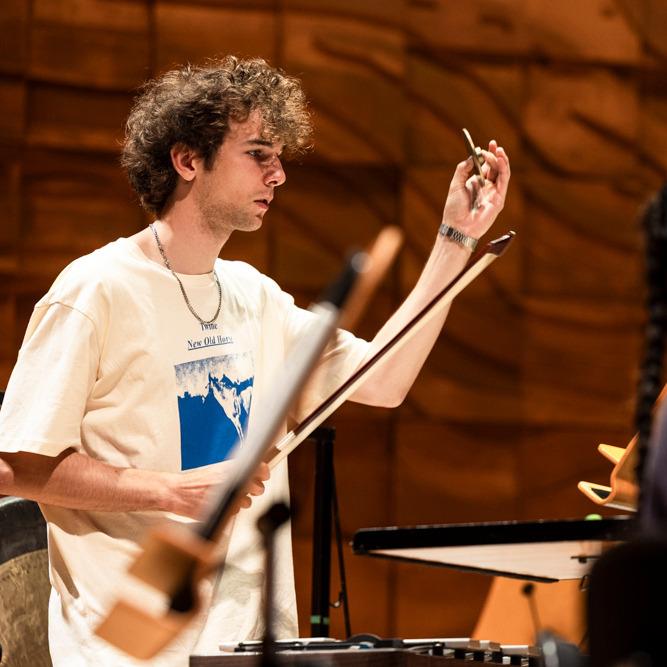
The passing of Per Nørgård in May last year marked the loss of a pivotal and influential composer within the world of percussion, and the Western classical canon as a whole. Composer Julian Anderson described Nørgård's style as "one of the most personal in contemporary music". Such praise is striking given Nørgård's fascination with profoundly non-human aspects of life, particularly the "Infinity Series" – a unique, self-similar mathematical sequence he used to structure melody, rhythm, and form in his compositions.
I thought it fitting to perform a recital devoted entirely to Per Nørgård’s music, illustrating both the range of his artistic interests and the emotional complexity of his work. There is an argument to be made that Nørgård is the most important composer of the late twentieth century. His work draws on early inspiration from key figures in the Western canon while also developing a distinctive compositional language shaped by mathematical processes and sustained experimentalism.
Pushing boundaries throughout his career, Nørgård consistently expanded the possibilities of musical form and language. While all four works in my recital draw on mathematical structures, the listening experience remains deeply personal, intimate, and disarming.
Early Influences and Inspiration
Per Nørgård’s early compositional period in the 1950s is characterised by a form of "Nordic Romanticism", drawing heavily on the symphonic traditions of Carl Nielsen and Jean Sibelius, as well as his studies with the renowned pedagogue Nadia Boulanger. Among her many distinguished students were Philip Glass, Aaron Copland, and Daniel Barenboim.
Particularly notable is Nørgård’s use of modal harmony and organic motivic development in works such as Symphony No. 1, Sinfonia Austera (1953–55) and Constellations for strings (1958). This period coincided with increasing cultural exchange across the Nordic countries, facilitated by the abolition of passport restrictions. In these early works, Nørgård confidently projected his Nordic musical identity onto the international stage.
Beyond Infinity
His second compositional period centres on Nørgård’s fascination with the Infinity Series throughout the 1960s and 70s. This method generates a self-similar, ever-evolving melody from a simple mathematical interval, which he used to structure harmonies, rhythms, and musical forms alongside concepts such as the overtone series and the Golden Section.
The fact that the Infinity Series provided material for more than one hundred works demonstrates not only its seemingly limitless potential, but also the remarkable curiosity and experimental spirit that characterised Nørgård’s compositional practice. The rhythmic series—a simple pattern of high and low notes, often referred to as "sun and moon" music—is found throughout his percussion works, particularly Nemo Dynamo (1991).
The first work in Friday's recital, Nemo Dynamo was written for percussion and electronic tape and was originally premiered at the Aarhus Computermusik Festival. Here, Nørgård pits man against machine: while the computer can perform infinity patterns at a wildly furious pace, the soloist exerts control over the whole through creative accents and playful tempo deviations that run contrary to the cogs of the machinery.
Hence the title's reference to Jules Verne's 1870 science-fiction novel Twenty Thousand Leagues Under the Sea. Captain Nemo's submarine may be technically superior, but it is ultimately man who steers the vessel and determines its course. The work serves as a reminder of the importance of the human creative voice in a world increasingly shaped by generative artificial intelligence.
The great change: from Mathematics to Modernist Art
Around 1980, a significant shift occurred in the music of Per Nørgård. A composer who had persistently and systematically employed mathematical principles as the fabric of his works, opening horizon after horizon, seemingly abandoned this approach after becoming deeply engrossed in the life and art of Adolf Wölfli, the Swiss artist whose visionary drawings emerged from a life marked by schizophrenia and institutionalisation.
This discovery expanded Nørgård's musical language, ushering in a new period of works that were more dramatic, psychologically complex, and multifaceted. His music became increasingly layered and expressive, juxtaposing moments of extreme chaos with passages of sublime harmony. I see his percussion concerto For a Change (1983), which I will perform in my recital, as a crossroads between the earlier "mathematical" period and this later, more erratic phase.
The solo percussion part of For a Change is a note-for-note adaptation of an earlier four-movement work, I Ching (1982). Around this solo line, Nørgård constructed a full orchestral score using the same compositional principles, reduced to piano for Friday's performance. My associate faculty member Daniel Le will perform this orchestral reduction, arranged by my former teacher Tim White.
I Ching takes its name from the ancient Chinese Book of Changes, a divination text in which chance operations generate an oracle, represented as a hexagram, that may offer insight into a situation or guide decision-making. Each movement of the work is titled after one of these hexagrams. For a Change draws upon the interplay of light and dark embedded within this tradition, an idea that also resonates with the opposing forces found in Nørgård's infinity-series rhythms.
So what is the connection to Wölfli? The structures and textures developed in I Ching later formed the basis of Nørgård's 1982 opera The Divine Circus, with the fourth movement functioning as a kind of overture to the drama. The opera recounts episodes from Wölfli's life, particularly the existential constraints imposed by long-term confinement in a psychiatric institution. Whether intended from the outset or not, the sudden shifts, capricious changes, and volatile contrasts throughout I Ching can be heard as reflecting aspects of Wölfli's inner world. One hears an almost claustrophobic intensity in the first movement, which stands in striking contrast to the serenity and beauty that emerge in the third.
Experimentalism and Its modern relevance
Although Nørgård’s upbringing and education were firmly rooted in the Nordic classical tradition, he was consistently experimenting with instrumentation, extended techniques, and tonality. Percussion writing remained largely unfamiliar within the more restrained Danish modernism of the 1950s, yet Nørgård was among the first to introduce the genre with his percussion ensemble work Rondo for 6 (1964).
Emerging from what he described as “the foaming sea of the new time,” the piece’s instrumentation and idiom were strikingly unusual for its context, contrasting inherited classical tonal language with freely structured, highly energetic sonorities. This avant-garde sensibility continued throughout his output. However, it was the combination of this approach with popular cultural influences that contributed to his distinctive style: references to The Beatles in Doing (1968) for brass ensemble, or the playful blending of pop and tango gestures in his three-movement piano suite Animals in Concert (1997).
“Something within me has never gotten over a certain contrast between fascination with the technical side of music and a fundamental, bottomless wonder that anything exists—including sound! This contrast was expressed in extreme forms in innumerable childish games I played: on the one hand, in my feeling for the stylistic mechanics of popular music, my playing by ear, and my sometimes elegant, sometimes irritating ‘cheating’—playing through a whole Beethoven sonata with the pedal more or less locked in the bottom position, until my piano teacher rang the doorbell, appalled (she had her teaching room in the floor above, unfortunately), and told me in no uncertain terms to practice properly and soberly; and on the other hand, in my great fascination with the bottomless sea of sound, expressed by playing on the strings inside the piano, mystical resonance experiments with vases, or—before I was ten—hand-turning popular 78 rpm records from my parents’ collection on a portable gramophone, producing strange bass moans of a violently disturbing kind from the grooves that were supposed to break into When I Think of My Little Alvida—until two boilermen knocked on the door, braving the lion’s cage, and with some nervousness, it seemed to me, peered down at the little noise generator with the innocent face…”
— Per Nørgård, Early Worlds: Close-Ups from My Childhood
Jon Parker’s recital will take place at 3.30pm on Friday 12 June in the Rosina Auditorium at Abbotsford Convent.