In the guest book of the Berg family residence, there’s a sketched caricature of 21-year-old Alban, sitting at the piano and obsessing over a score of Richard Wagner’s Parsifal. Another book with the word “Schönberg” lays to the side, closed. What metaphor does one make from this? Surely it’s not a symbolic rejection of Schoenberg’s promised future of music, a rejection of the “emancipation of dissonance” for the Romantic world of German expressionism. And yet…
If I were to sum up Alban Berg in a couple of words (however inadequate this arbitrary limitation is), it would be “meticulous obsession.”
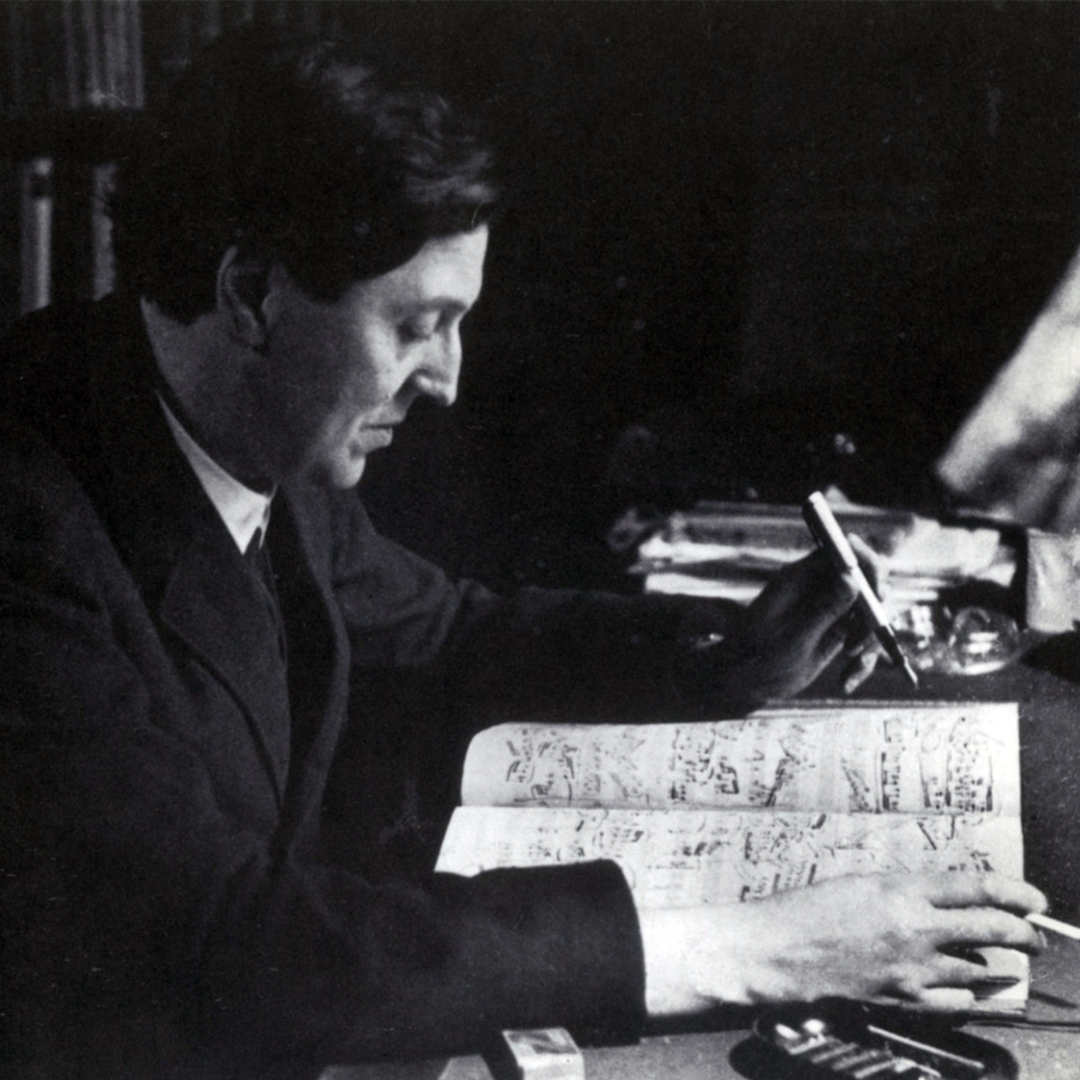
A gentle genius holds his pen, utterly confident in his mastery of compositional tools without the ego that weighed down so many before him.
Like all roads leading to Rome, every idea in twentieth-century music intersects with Pierre Boulez. Of Schoenberg’s Second Viennese School, it was Anton Webern that the French firebrand admired the most, and saw the future in. To Boulez, the caricature summed up Berg’s output: too sentimental, too Romantic.
Webern’s music was tightly coiled modernism that took Schoenberg’s twelve-tone ideas seriously and adhered to this newfound ‘serialism’ – taking pre-arranged sequences of these twelve tones and treating their development strictly. Berg’s music was too melodious – how could this expressive music possibly fit within the rules of this cold, ascetic brave new world of mathematical precision? On Berg’s Violin Concerto, which references folk song and J.S. Bach’s Es ist genug, Boulez said: “Dodecaphony has more pressing duties than to tame a Bach chorale.”
This is the great paradox of Alban Berg. Within his so-called melodic treatment of twelve-tone material are quite literally encoded messages and themes. With an open letter published alongside his Chamber Concerto, Berg explains that the work is a tribute to Schoenberg, and encodes the names of Schoenberg, Webern, and himself through the work (‘ArnolD SCHönBErG’, ‘Anton wEBErn’ and ‘AlBAn BErG’ – using the German system where H is B and B is B-flat) and using the number three to determine the structure, tempi, instrumentation and more. But beyond what Berg makes clear in his letter, the themes go deeper, with the first movement variations on each of the three composers’ motifs, the second movement a complicated love story of Schoenberg and his wife Mathilde (even quoting Schoenberg’s Pelleas und Melisande), and finally wrapping them all together in a closing movement, given the draft title ‘The World’.
All of this in one of the most virtuosic works for the violin and piano, which, for an overtly twelve-tone work, is at each turn playful, joyous, brash and entirely one of a kind.
Whether you’re already aware of Berg’s brilliance or just starting out your journey into his unique musical world, Jeffrey Means and ANAM’s musicians will guide you through the brilliance that makes Berg deserving of the title alchemist.
Words by Alex Owens, ANAM Music Librarian, Robert Salzer Foundation Library
THE ALCHEMY OF ALBAN BERG
Friday 21 August 7pm
Rosina Auditorium, Abbotsford Convent
Book Now
Alban BERG Sieben frühe Lieder
BERG Piano Sonata, op. 1
Johann STRAUSS II arr. BERG Wein, Weib und Gesäng, op. 333
BERG Kammerkonzert, op. 8
Roger Benedict conductor
Timothy Young (Resident Faculty, Head of Piano) piano
Sophie Blades (guest) soprano *
ANAM Musicians
* Sophie Blades is a 2026 Melba Artist and appears courtesy of the Melba Opera Trust

Tickets Standard $45 | A Little Extra $65 | A Little Less $25