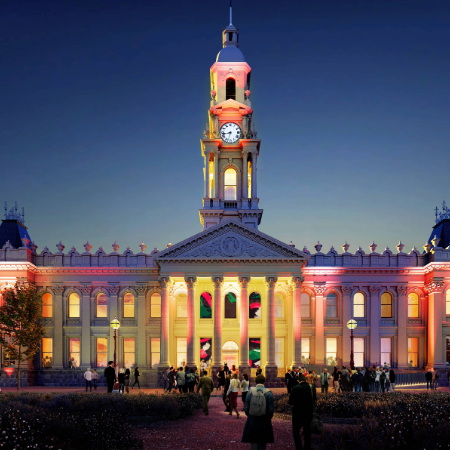
ANAM Managing Director Nick Bailey and Architect Peter Elliott AM sit down to discuss the project
How’s the project going?
Nick Bailey (NB): “What Peter and his team have come up with is quite remarkable. This is a building that opened in 1879, and Peter’s designed it in such a way that it will excel as a 21st-century music school that won’t just serve ANAM’s vision for the next 50 years but will be a community hub as well. We want people in the building every night of the week for performances.”
Peter Elliott AM (PE): “There are constant surprises every day. Working on a building as old and as rich in history as this one, means it’s a journey of discovery. There are also particular requirements for a performance venue, and that combination makes for quite a complex project. But that’s also what makes it exciting. We’re having an enormously valuable time with the ANAM team envisaging this project. As tricky as it is, it’s also rewarding.”
What are some of those unique requirements for a performance venue?
PE: “A big one is acoustics. For instance, the main central hall has a large uninsulated roof, which has almost no acoustic value. Previously, when ANAM was in there and it rained, the orchestra often stopped performing until the rain stopped! So that’s the first task, to secure the building to minimise external noise, and the leakage of internal noise into the surrounding residential area.
“The second task is acoustically tuning each room to its unique requirements – the main hall requires acoustic reflectors, for example, floating within the auditorium. Retrofitting that within a 19th century building is challenging, although a great advantage here are the very tall ceilings.”
You’ve extensively consulted with local Wurundjeri Elders. How has this informed the design?
PE: “We held a series of co-design workshops where we presented ideas about the building and listened to the Aunties reactions. The big thing we’ve learned is that this site was a major meeting place for the Boonwurrung and Wurundjeri in particular. The Aunties love the idea that ANAM will bring music, performance and the gathering of people back to this place, which is an extension of what it always was. It’s also informed how we’ve thought about the main performance rooms and our design approach to include references to the colours of Country, landscape, and sky Country themes.”
NB: “The consultation between Peter’s team and Wurundjeri Aunties has been beautiful. In a very real way, it informed how we’re designing the default space as an audience in a circle around the performers. It can be reconfigured into a standard Western concert hall, but this default space is a powerful symbol of connecting us together. The musicians aren’t above the community, they’re part of it.”
PE: “There is no fixed seating in the building. You can assemble according to the type of performance and the audience engagement you want.”
The South Melbourne Town Hall is a beautiful old building. How complex is it to make it work for ANAM’s needs, compared to simply designing something new?
NB: “When we first started thinking about this project, many people around town told me we’d be better off just constructing something new. But I think that having an existing blueprint is far better than starting with a blank piece of paper. Maybe it’s something about the classical music mindset - dealing with that sort of complexity, and those challenges. It did mean that for the first 12 months, Peter’s job was just problem solving!”
PE: “The great thing about a building like this is the incredible diversity of room types and atmospheres within it, reflecting its history. It wasn’t just a council office, the building had a post office, a courthouse, it had police cells, a little fire brigade and a Mechanics Institute, which we have inherited That’s the joy of the building.”
NB: “The South Melbourne Town Hall is a key part of the local community, and we want ANAM to retain that deep connection. Music exists to be listened to – it requires that community connection.”